From Transistor to System: A Friendly Guide to Computer Architecture
Demystifying the ghost in the machine. A journey from raw silicon and jumping electrons to the sophisticated multicore systems that power our modern world.
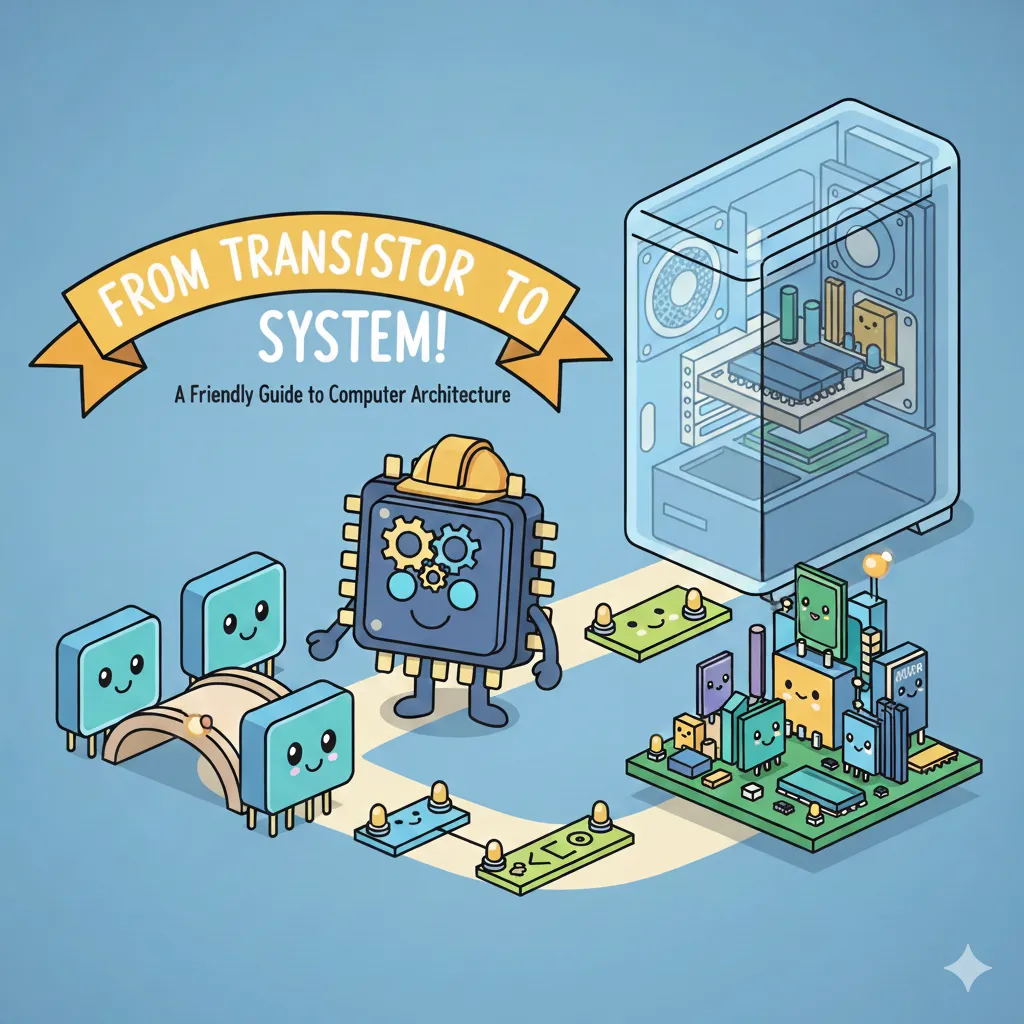
How does a piece of silicon “think”? Most developers treat the CPU as a black box that executes code, but understanding the physical and logical constraints of the hardware makes you a better programmer. This series breaks down the abstraction layers of a computer, starting from a single electron and building up to a modern System-on-Chip (SoC).
We follow the evolution of computing through seven core chapters:
The Curriculum
Chapter 1: How Transistors Work: From Semiconductors to MOSFETs
A deep dive into the world of transistors. Learn about semiconductor physics, P-type vs N-type doping, and how MOSFETs function as the building blocks of CPUs.
Chapter 2: Logic Gates & Memory: Building an 8-Bit Adder from Scratch
Master the building blocks of digital logic. Learn how transistors form AND/OR gates, how Full-Adders perform binary arithmetic, and how Flip-Flops create computer memory.
Chapter 3: How an ALU Works: The Heart of CPU Architecture Explained
Don't just read about the ALU, learn how to build one. Let's break down the Arithmetic Logic Unit into 1-bit circuits using adders, multiplexers, and logic gates. Perfect for students of computer architecture.
Chapter 4: The Control Unit: The Brain Inside the CPU
Discover how the Control Unit (CU) orchestrates the CPU. Learn the mechanics of instruction decoding, hardwired vs. microprogrammed logic, and the role of microcode.
Chapter 5: The Memory Hierarchy: From CPU Registers to Long-Term Storage
Master the computer memory hierarchy. Learn the critical differences between L1/L2/L3 cache, RAM, and SSDs, plus how the MMU handles virtual-to-physical address translation.
Chapter 6: The CPU in Action: Mastering the Fetch-Decode-Execute Cycle
The grand finale of our architecture series. Follow a step-by-step walkthrough of the Fetch-Decode-Execute cycle to see how the ALU, Control Unit, and Registers create a thinking machine.
Chapter 7: Beyond the CPU: I/O, Buses, and Multicore Systems
Discover how CPUs talk to the outside world. Learn about memory-mapped I/O, DMA, the role of GPUs in parallel processing, and modern System-on-Chip (SoC) design.
What You’ll Need
- An interest in how hardware works.
- No electrical engineering degree required, we use “water hose” analogies to keep things grounded.
- A basic understanding of binary (though we recap the essentials).
Ready to see the magic? Start with Chapter 1: How Transistors Work and see how we turned sand into logic.