Series
The Tough Love Architecture Guide
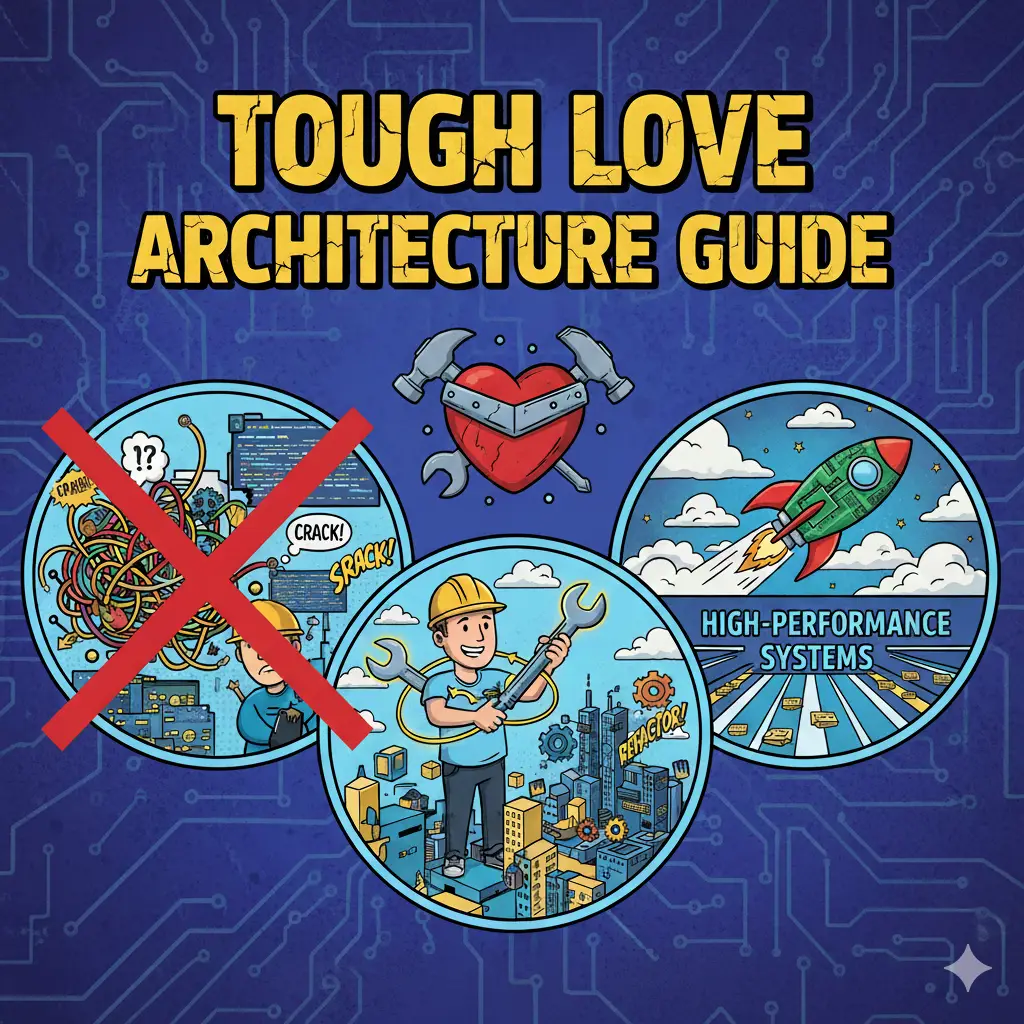
Stop pattern-worshipping and start solving problems. A cynical but practical journey through software design, incremental refactoring, and high-performance systems.
By Nathan Updated 1 min Beginner
On this page
Software architecture is often taught as a collection of “perfect” diagrams, but the real world is messy, constrained, and full of deadlines. This series isn’t about memorizing the Gang of Four; it’s about developing the judgment to know when to use a pattern and, more importantly, when to leave it out.
In this collection, we move from the philosophy of “No” to the hands-on surgery of refactoring, ending with the patterns that actually power high-scale systems.
The Curriculum
- 01
The Art of Saying No: The Harsh Truth About Design Patterns
Stop pattern-worshipping and start solving problems. Learn why most developers misuse design patterns and how to pick the right architecture for real-world constraints.
- 02
The Rescue Mission: Refactoring a 'Monster' Class Step-by-Step
Don't delete that messy code just yet. Learn how to transform a tightly coupled Java class into a clean, testable architecture using incremental refactoring and abstractions.
- 03
Design Patterns for Performance: Scaling Beyond Simple Code
Master high-performance architecture. Explore the Reactor pattern, Actor model, and resilience strategies like Circuit Breakers and Load Shedding for low-latency systems.
What You’ll Need
- A healthy skepticism of “perfect” code.
- Basic familiarity with Object-Oriented Programming (examples are in Java/General Pseudocode).
- Experience having felt the pain of a “spaghetti factory” codebase.
Ready to get real? Start with Chapter 1: The Art of Saying No and learn why your favorite pattern might be your biggest liability.
Would you like me to generate a specific “Cheat Sheet” table comparing the Concurrency Patterns (Reactor vs. Actor vs. Fan-out) mentioned in Chapter 3?
Get the next part
New parts of The Tough Love Architecture Guide land in your inbox the day they publish. No spam, unsubscribe in one click.
We send your address to Kit, our email provider, and ask you to confirm by email before anything is sent. See our Privacy Statement.