Finding P values and false hope: A Guide to Risk and Quant Finance
From simple bets to complex bond portfolios. Explore the mathematical structures of uncertainty, debt mechanics, and the Python tools used to model them.
Quantitative finance is often shielded behind a wall of intimidating jargon and Greek letters. This series tears that wall down. We treat financial markets not as mystical entities, but as complex, non-stationary data systems that can be modeled, simulated, and stress-tested.
By moving from the historical “philosophy of risk” to hands-on Python implementations of Mean-Variance Optimization and Monte Carlo VaR, we audit the mechanisms that move global capital. How do you price a bond when interest rates are a moving target? How do you engineer “safety” out of a pool of risky loans? This series is a rigorous audit of the math that powers Wall Street.
The Curriculum
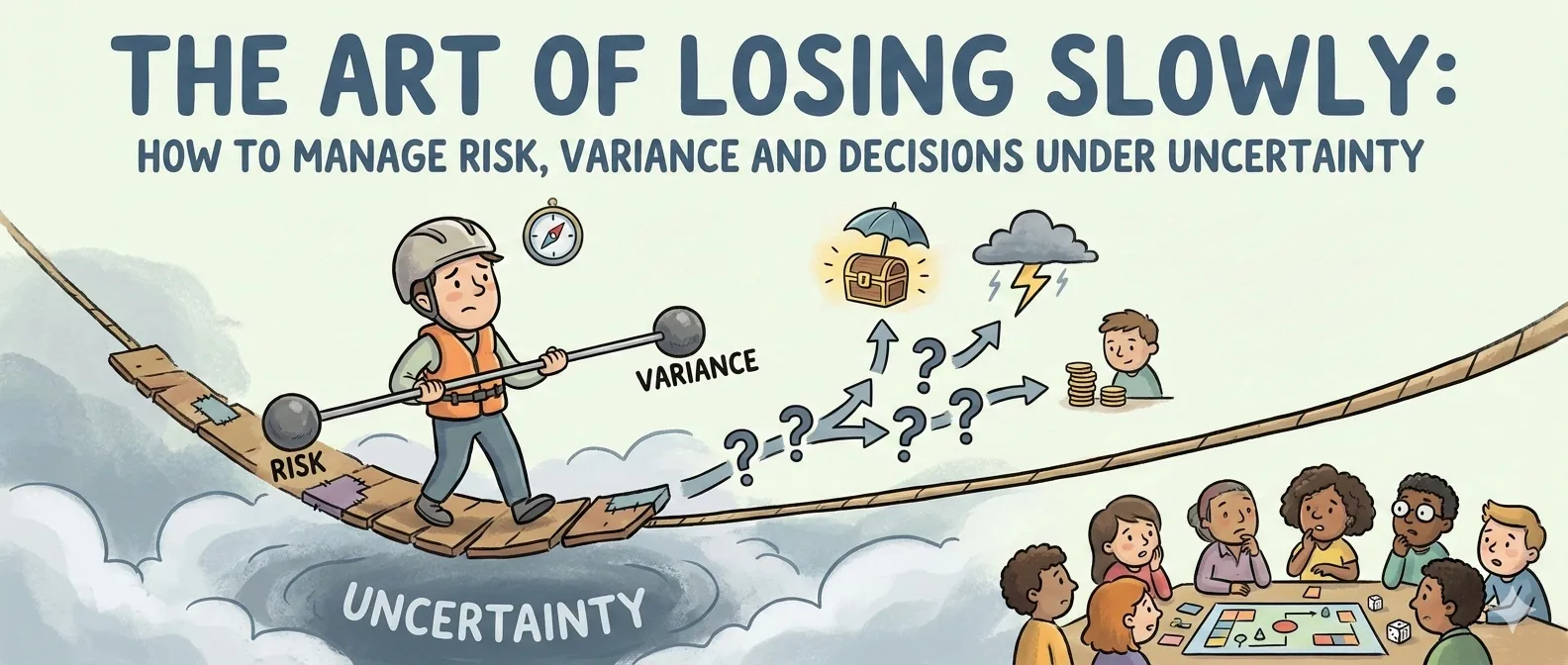
Chapter 1: The Art of Losing Slowly: Risk, Variance, and Decision-Making
Master risk management through the lens of variance and expected value. Learn how to size bets, diversify risk, and implement decision-making logic in Python.
Chapter 2: Loans and Bonds: The Mechanics of Borrowing and Default Risk
A quantitative guide to loan amortization and bond pricing. Learn to derive payment formulas, simulate default risk, and understand coupon rates using Python.
Chapter 3: Life in the Tranches: Understanding CDOs and Risk Waterfalls
Learn how CDO tranching splits credit risk into Senior, Mezzanine, and Equity layers — with a step-by-step Python waterfall simulation.
Chapter 4: The Geometry of Interest: Constructing Yield Curves and Forward Rates
Master the term structure of interest rates. Learn to build yield curves using bootstrapping and interpolation, and derive forward rates with practical Python examples.
Chapter 5: Stock Analysis with Python: Modeling Prices, Returns & Distributions
Learn how to analyze stock market data using Python. This guide covers calculating daily returns, visualizing volatility, and modeling statistical distributions with yfinance.
Chapter 6: Portfolio Allocation: The Math Behind the Efficient Frontier
Master the quantitative core of Modern Portfolio Theory. Learn how to use Markowitz optimization and Python to build an efficient frontier for asset allocation.
Chapter 7: Stock Options 101: A Guide to Calls, Puts, and Pricing
Unlock the basics of stock options. Learn the difference between calls and puts, American vs. European styles, and how Greeks like Delta and Theta impact pricing.
Chapter 8: Value at Risk (VaR) vs. CVaR: A Practical Guide for Investors
Stop using abstract volatility. Learn how to calculate Value at Risk (VaR) and Conditional VaR (CVaR) using Python to understand your actual downside potential.
Chapter 9: The Random Walk: From Coin Flips to Stochastic Calculus
Discover how a simple coin flip evolves into the mathematics powering modern derivative pricing. From Binomial Trees to the Wiener Process and the Heat Equation; we handle all in Python.
Technical Stack & Methodology
This series bridges the gap between financial theory and production-grade data science:
- Data Acquisition: Real-time and historical data fetching using
yfinance. - Numerical Computing: Matrix algebra and optimization using
NumPyandSciPy. - Modeling:
- Stochastic Simulation: Monte Carlo methods for path-dependent outcomes.
- Optimization: Lagrange Multipliers for constraint-based asset allocation.
- Inference: Bootstrapping and interpolation for curve fitting.
- Visualization: Detailed risk-return plotting using
MatplotlibandPandas.
What You’ll Learn
- The Math of Money: How to calculate the “fair” price of risk and time.
- Structural Integrity: How complex products like CDOs are built (and why they break).
- Modern Allocation: How to build a portfolio based on covariance, not just “gut feeling.”
- Tail Risk Awareness: Why standard bell curves fail in a crash and how to model the “unlikely” 1% event.
Disclaimer: This series is for educational and analytical purposes only. Quantitative models are approximations of reality, not guarantees of profit. All trading involves substantial risk of loss.