The Art of Losing Slowly: Risk, Variance, and Decision-Making
Master risk management through the lens of variance and expected value. Learn how to size bets, diversify risk, and implement decision-making logic in Python.
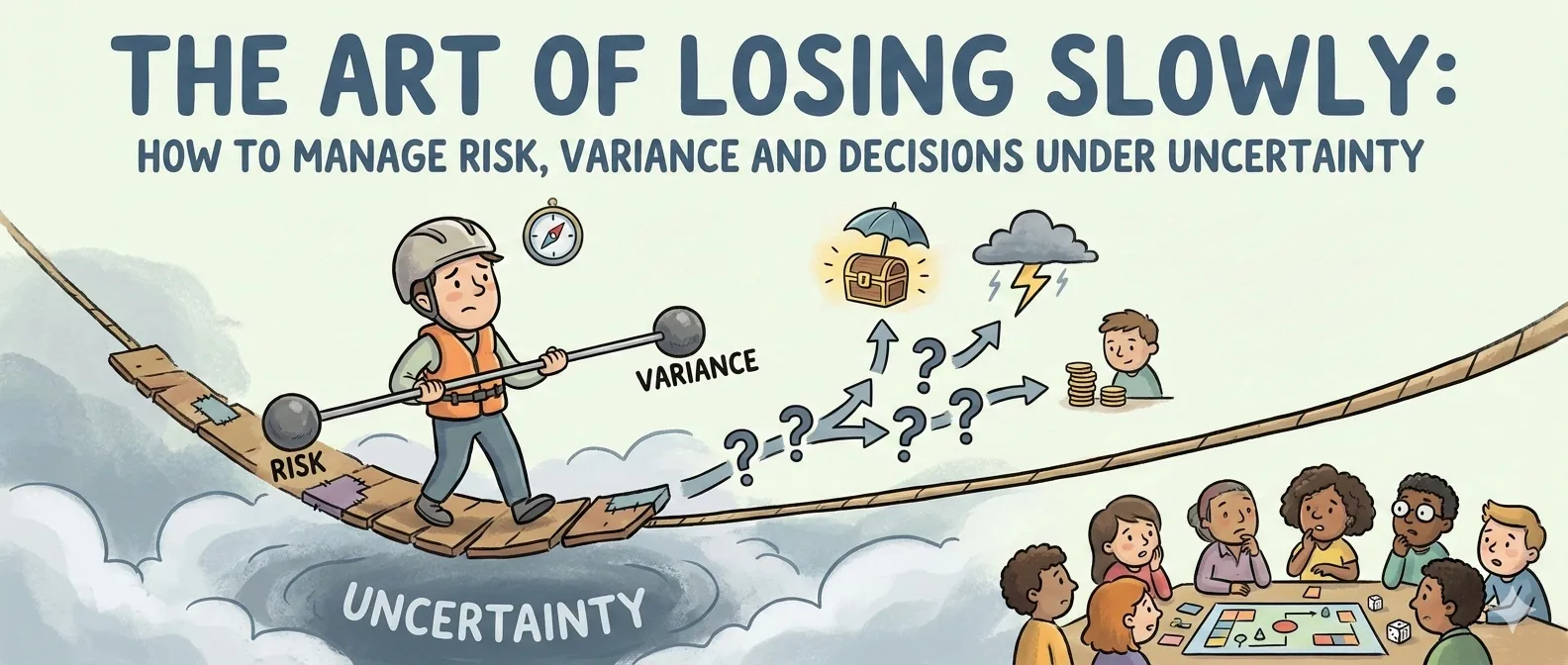
In a world obsessed with winning, few stop to consider the quiet art of losing. Not making reckless decisions, but instead being deliberate, patient, and purposeful. Managing risk and making decisions under uncertainty isn’t about avoiding loss; it’s about controlling its space, size, and impact. Success often belongs not to those who never fall, but to those who learn to fall well, who can endure small, calculated setbacks while keeping the bigger picture intact.
Learning to “lose slowly” means embracing uncertainty without panic, balancing conviction with adaptability, and knowing when to press forward and when to hold back. It’s playing the long game when the short term feels chaotic. By learning to lose slowly, we will be able to separate sustainable progress from mere luck.
Understanding Risk
Risk is woven into almost every decision we make. We take it when we cross the street, start a new job, or trust someone’s word. Most of the time, we manage it intuitively, weighing outcomes, reading context, and adjusting as we go. Every day life trains us to navigate uncertainty, but it can create a dangerous illusion of being too comfortable with risk and of underestimating it.
In financial decisions, those illusions often break down. Even highly educated people who hold strong opinions about financial markets and financial risk struggle with it. The 2008-2009 financial crisis is a clear example of how financial risk was underestimated. It’s important for us to have a deep enough understanding to manage the risk we can live with.
Let’s explore an example of risk evaluation in a financial decision involving gambling. Imagine this: you pay €1 to draw a single card from a standard deck. If you pull the ace of spades, you win €50; otherwise, you get nothing. Would you take the bet?
Most people would since it feels like a small risk for a high reward. But let’s change the game. Would you play the banker? So now you get €1 if no ace of spades is drawn, but you lose €49 if an ace is drawn.
We can make this game more fun by upping the stake by x100. Most of us would probably hesitate to lose €4900 just to gain €100. This just feels like a bad deal, even though the odds are the same as with the lower amounts. We can calculate the expected value of this bet as:
So the bet still has a positive outcome, but what if we split it into 50 even smaller bets? With each round, we risk losing €98 and have a chance to gain €2. Our maximum possible loss is still €4900, and the maximum possible gain is still €100. Did you notice what happened when we changed the game like this? The probability of us losing everything just changed to almost zero (about 10^-86), while the probability of obtaining the maximum gain is (51/52)^50 = 37.87%.
What changed? Not the expected outcome—what stayed the same—but the variance did change. Variance captures how spread out the possible outcomes are, and it turns out to be a powerful way to distinguish a good from a bad bet.
The essence of variance is dividing a single large, risky bet into many smaller, uncorrelated ones. In finance, diversification transforms uncertainty into something manageable. It’s why investors might prefer to hold a 1% stake in 100 mortgages than a 100% stake in one. The total exposure is the same, but the risk behaviour is completely different. This is a great example of managing risk by leveraging variance.
Making decisions under uncertainty
Every meaningful decision we make lives in the space between what we know and what we can only guess. Whether we’re allocating capital or choosing when to exit a trade, uncertainty is the constant backdrop. Yet decisions must still be made. Good decision-making under uncertainty is not only about the probability of an event, but also about the consequences if it occurs. A rare event with a large impact can matter far more than a frequent one with small effects. However, in practice, this can be very difficult, since there are an infinite number of possible outcomes for certain events. For simplicity, let’s imagine we have an event with a finite number of possibilities. Imagine we have a company that runs online ads. We need to decide whether to place the ad online. Based on historical data, we know the probability and outcome of each decision we can make:
| Decsion | Probablity | Outcome |
|---|---|---|
| Place the ads | 20% | Customer buys → €5 profit |
| 30% | Customer does not buy → €1 loss | |
| Do not place the ads | 50% | Customer shows interest but doesn’t buy → €0 profit |
There are several ways to evaluate the risk and the actions we should take. Let’s discuss two simple methods to understand the principle of decision-making. The first one is the expected value decision. With this decision, we will calculate the expected value of each outcome with this formula:
We can easily automate this decision-making process with Python. By defining the possible outcomes and their probabilities for each decision, the script will compute the expected value and compare your options programmatically.
def expected_value(outcomes):
    """
    outcomes: list of (probability, payoff) pairs.
    """
    return sum(p * v for p, v in outcomes)

def evaluate_decisions(decisions):
    """
    decisions: dict where key = decision name,
               value = list of (probability, payoff) pairs.
    """
    results = {}
    for name, outcomes in decisions.items():
        results[name] = expected_value(outcomes)
    return results

if __name__ == "__main__":
    # All the options and their possible outcomes
    decisions = {
        "Place the ad": [(0.2, 5), (0.3, -1)],
        "Do not place the ad": [(1, 0)],
    }

    ev_results = evaluate_decisions(decisions)
    # Identify the best decision
    best_decision = max(ev_results, key=ev_results.get)
print(f"Best decision under the Expected Value criterion: {best_decision}")So we should place the ads based on the expected value decision. In general, we should make decisions based on expected value if the decision is made often enough for the law of large numbers to apply. The decision in our example is for every person who interacts with the ad. So in the end, we should make the most money by placing the ad.
Not all decision makers will find this approach appropriate for this situation. A risk-averse decision maker will be more interested in minimising their loss. They will use the worst-case decision-making method. The decision based on the worst-case scenario should be made when it is a one-time occurrence and the worst-case scenario has a catastrophic effect. In this case, we should always cover the worst case. The worst-case scenario calculation does not account for the probability of an event. We simply look at what it would the worst possible outcome is.
Imagine we are going on holiday and you get the option to buy travel insurance. The total trip costs you €5000, and you can buy additional travel insurance for €200. So what could happen?
| Decision | Outcome |
|---|---|
| Buy Insurance | Trip is fine → €200 loss |
| Trip is canceled → €200 loss | |
| Do NOT buy Insurance | Trip is fine → €0 loss |
| Trip is canceled → €5000 loss |
The worst thing that can happen is us losing €5000 if we don’t buy the insurance and the trip gets cancelled. Therefore, a risk-averse decision maker will choose to buy the insurance when going on the trip.
Closing thoughts
Learning to lose slowly is not about avoiding failure; it’s about respecting uncertainty. It’s recognising that progress is rarely a straight line and that the cost of staying in the game is sometimes accepting small, intentional losses along the way.
We don’t control outcomes, but we do control our exposure: how much we risk, how often, and in what context. By diversifying, by sizing our decisions to our tolerance, and by keeping a long-term perspective even when the short term feels chaotic, we can build a path where setbacks are manageable rather than catastrophic.
In the end, winning isn’t about making the right decision every time. It’s about creating a system in which even the wrong decisions don’t break you.
⚠️ Financial Education Disclaimer
The concepts and Python simulations discussed in this post (including Expected Value and Variance management) are for educational and philosophical purposes only.
- Probabilistic Nature: Statistical models like “Expected Value” describe long-term averages; they do not predict the outcome of any single event. You can make the “right” decision and still experience a “wrong” outcome.
- Model Limitations: Real-world risks are rarely as clean as a deck of cards or an insurance table. “Black Swan” events—outliers that fall outside standard probability distributions—can occur and cause losses exceeding what a model predicts.
- Personal Tolerance: Every individual has a different “Risk of Ruin.” A positive Expected Value (+EV) bet may still be inappropriate if the potential loss jeopardizes your financial survival.
- Not Financial Advice: Decisions under uncertainty involve significant peril. Always consult a qualified professional before making high-stakes financial or insurance commitments.