Stock Options 101: A Guide to Calls, Puts, and Pricing
Unlock the basics of stock options. Learn the difference between calls and puts, American vs. European styles, and how Greeks like Delta and Theta impact pricing.
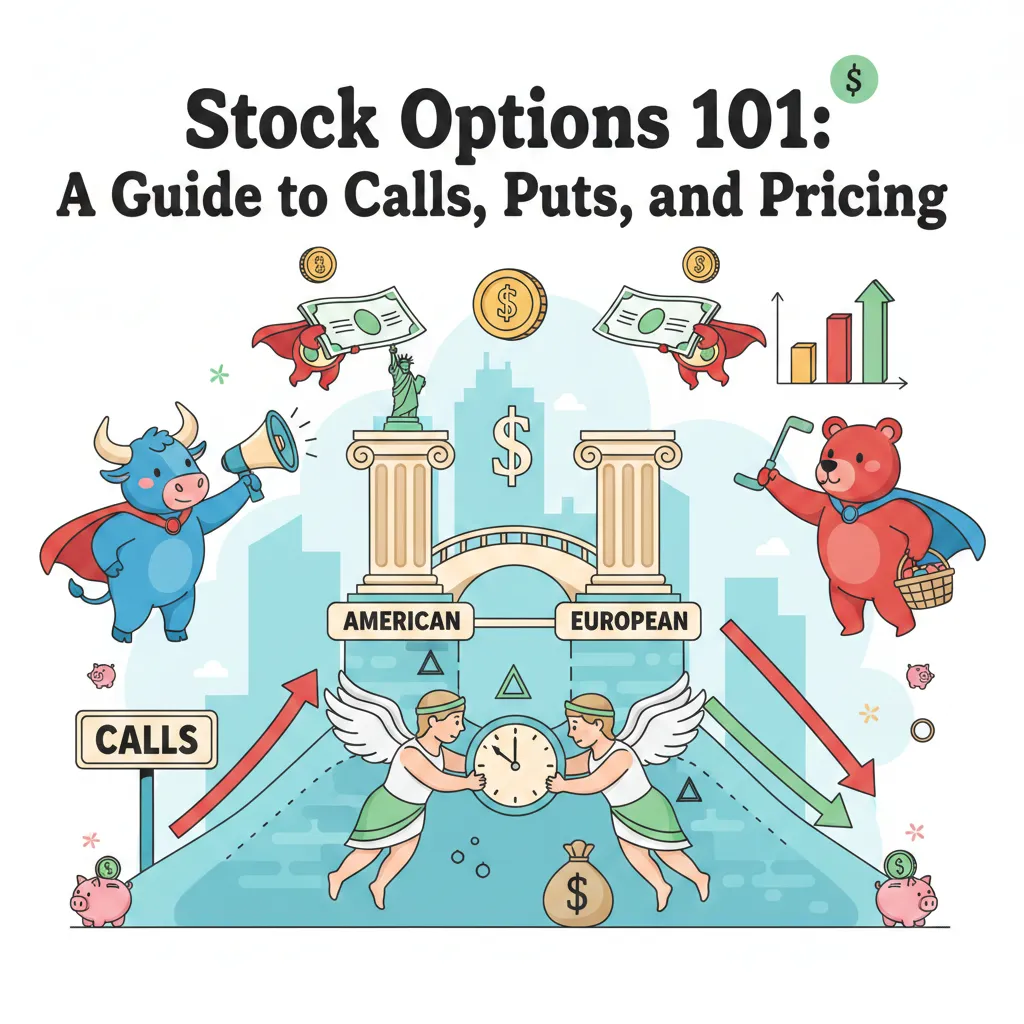
In this post, we will start exploring a new financial instrument, stock options. Simply put, stock options allow the holder the right, but not the obligation, to trade the security at or during some future time. Stock options are a complex instrument that can be used in many ways, such as protecting our portfolio from a market crash or amplifying our gains. In this post, we will see how stock options work so we can start working with them in future posts.
The basics
Call options vs Put options
Primarly their are two flavors of options: Calls and Puts. Call options give the owner the right to buy a security at a set price (the strike price k). People buy call options (go long) when they expect the price to rise. Call options are much cheaper than buying the actual stock. For a small premium, you can control 100 shares. If the stock price jumps, your percentage gain is a lot higher than if you had owned the stock. Another benefit of buying a call option is the limited risk. For example, if you buy a stock for €100 and it goes to zero, you lose €100. But if you buy a call at a €100 strike for a €5 premium, and the stock goes to zero, you only lose the €5 premium.
But if you get all this as a buyer, why would someone sell (or write) an option? The most common reason people write options is when they own a stock and expect the price to stay flat. You sell the call option to someone and immediately collect the premium. If the strike price is never hit, you keep the stock and profit from the premium. As a writer of the call option, you are, in essence, acting as the insurance company and will make a profit from people betting against the market.
The put option gives the owner the right to sell a security at a set price (the strike price k). People buy put options when they expect the price of a stock to decline. For example, if you own a stock and are scared the market will crash, you buy a put. No matter how low the market goes, you are guaranteed the right to sell your shares at the strike price K.
People who write put options do that to acquire stocks at a discount. If you want to buy a stock at €90, but it is currently trading at €100, you can sell a €90 strike put option. If the stock price drops to €90, you will be forced to buy it, but effectively, you got it for even cheaper because you already collected the premium. Another strategy for writing put options is when you assume the strike price will never be hit. In that scenario, you will simply make a profit from the premium, and the option expires worthless.
American vs European vs Bermudan
Now that we know the difference between calls and puts, we need to understand when these options can be exercised. The three main flavors for when an option can be exercised are American, European, or Bermudan.
American options can be exercised at any time between the date op purchase and the expiry date. This means that you don’t have to wait for the finish line. If a stock skyrockets on Tuesday and your option expires on Friday, you do not have to wait. You can exercise the option immediately and collect your gains. Because of their flexibility, American options are often the most expensive, with the highest premiums.
A European option can only be exercised at the very end of its life, at expiration. This means that even if the stock price jumps two weeks before expiration, the holder can not force a sale or purchase of the stock until the option expires. European options are often cheaper than American options because the seller can not be forced to trade at any given moment. This predictability makes the math behind pricing much easier.
Bermudan options sit between American and European options, in that they can be traded at several predetermined dates between purchase and expiry. For example, an option might expire in 1 year, but the holder may make a purchase or sale on the first business day of each month. These types of options are rarely found on public retail exchanges and are mostly traded in private. The price for this type of option also falls between that of an American and a European option.
Why use an option
There are many different ways people use options. It is almost a chooce your own adventure financial tool. Your risk profile depends entirely on how they are used. The four main strategies people use when trading options are: Hedging, Leverage, Income, and Strategic Entry.
Hedging: The Insurance Strategy
Hedging is probably the most fundamental use of options. It is designed to protect an existing position from tail risk (un unlikely but devastating event). Imagine you own 100 shares of a tech company. You love the company long term, but are worried about an upcoming earnings report. By buying a put option, you establish a floor price. If, in this scenario, the stock price crashes, it starts gaining dollar-for-dollar value below the strike price. You have paid a premium to ensure you never have to sell below a certain level.
Leverage: Boosting Capital Efficiency Strategy
Options allow you to control the movement of a stock for a fraction of the price of owning the shares. This is often called Gearing. If a stock trades at €200, buying 100 shares will cost you €20,000. Alternatively, you could buy a call option with a premium of €5 for the same 100 shares for a contract costing only €500. If the stock rises to €220, the person who bought it will have made € 2,000 on a €20,000 investment, which is a gain of 10%. If you bought the option, it would now be worth €20 (the stock price minus the strike price). This means the €500 contract is now worth € 2,000, a gain of 300%. However, the catch with this option strategy is that if the price remains unchanged, the contract will expire worthless. The option investor will then lose his €500 while the stock owner will have lost nothing.
Income Generation: Turning volatility into cash Strategy
Conservative investors can use options to generate a yield on the stocks they already own. It is like collecting rent for a house. If you own a stock and expect this stock to trade sideways (the price stays the same), you can write a call option to someone else. You will immediately recieve the cash for the premium paid by the buyer. As long as the stock does not rise above the strike price, you will keep both the stock and the cash for the premium. It lowers the so-called cost basis for owning a stock. The risk with this strategy is that you could give up extra profits if the stock suddenly goes to the moon.
Strategic Entry: Buying at a discount strategy
Options can also be used to get paid for waiting to buy a stock you wanted to own anyway. If you want to buy a stock at €90 but it is currently trading at €100, you can sell a put option with a strike price of €90. This strategy is seen by some as win-win. If the stock stays above €90, you keep the premium and will have made money for doing nothing. If the stock drops below €80, you will be forced to buy it at 90. While this sounds like a loss, remember that you wanted to buy it anyway, and your €10 loss is effectively lower because you will still have the cash from the premium.
How are options priced?
The most important driver of option prices is the underlying stock price. However, there are some so-called invisible forces that will pull the price up or down. The simplest of these components is the profit currently built into the option.
- For a Call: InstrinsicValue = CurrentStockPrice - StrikePrice
- For a Put: InstrinsicValue = StrikPrice - CurrentStockPrice
If the Intrinsic value is zero, the option is out of the money and has no value if sold today.
Besides the intrinsic value, the option price is also affected by the extrinsic value. The extrinsic value is determined by the markets expextation of the future. When the value of stock S moves, the option price moves with it. Delta measures this sensitivity.
- Calls: Price goes up when the stock goes up
- Puts: Price goes up when the stock goes down
Options are wasting assets. Every day that passes, the chance of a high price move decreases. This time decay is measured by theta. As you get closer to the expiration date, the option price leaks value. This decay accelerates rapidly in the final 30 days before expiration.
Volatility is perhaps the most misunderstood and hardest to judge driver. Volatility represents the expectation of how much the stock will swing. If the market expects a massive move, the option price becomes more expensive than if the stock price is expected to stay the same. This is measured by Vega.
Another driver is the relationship between the strike price and the current stock price. The closer the strike price is to the actual stock price, the more it will be influenced by the stock. If the strike price is farther from the stock price, hitting the strike becomes more of a gamble, making the option less dependent on the movement of the stock.
Finally, interest rates also have a small effect. When rates rise, call options become slightly more expensive while put options become cheaper. This is because buying a call is seen as an alternative to buying stock on credit. As borrowing cost rises, the right to buy a stock for a given price at a future moment becomes more valuable.
⚠️ Financial Education Disclaimer
This post is for educational purposes only. Options trading involves significant risk and is not suitable for all investors.