From Transistor to System: A Friendly Guide to Computer Architecture
Learn how computers work from transistors and logic gates to ALUs, control units, memory, instruction execution, I/O, GPUs, multicore CPUs, and SoCs.
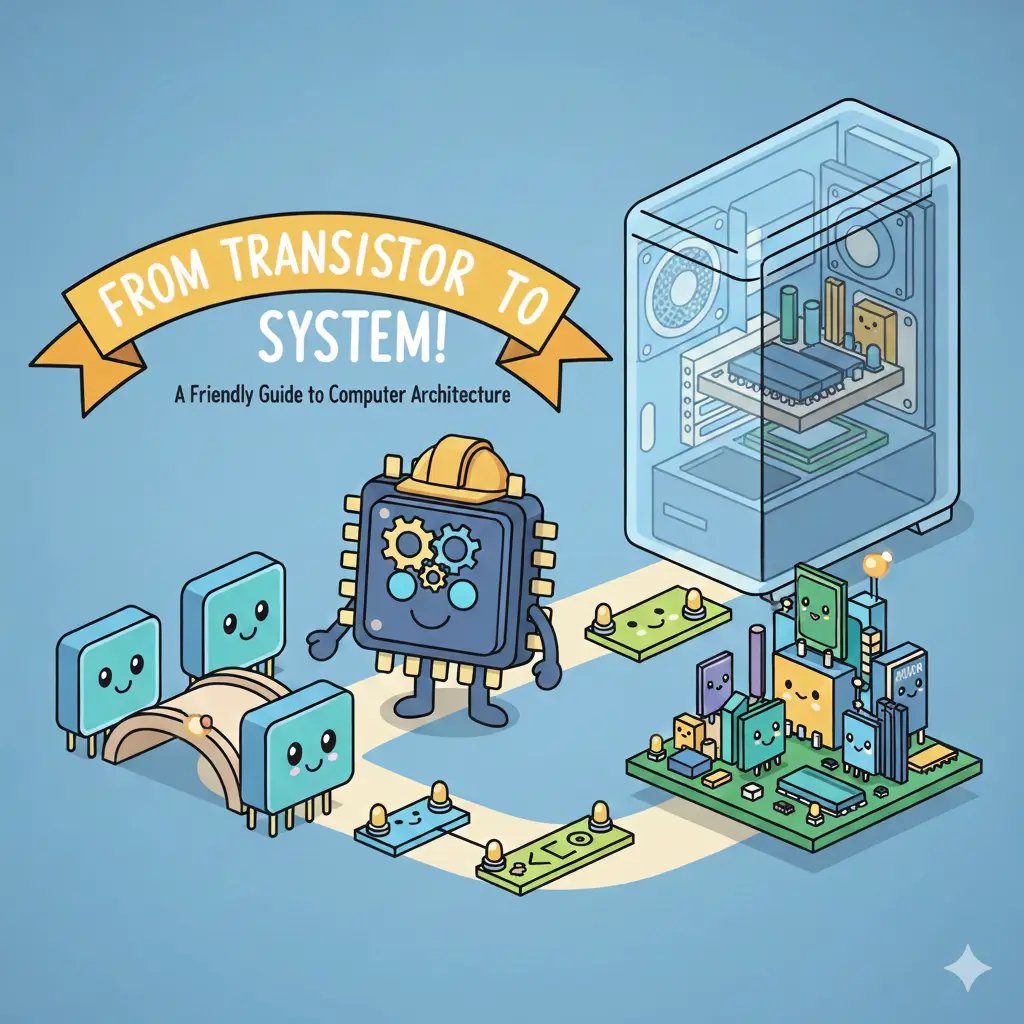
How does a computer turn electrical signals into software, graphics, memory, and complex calculations?
This computer architecture tutorial follows that journey one layer at a time. It begins with silicon, semiconductor doping, and MOSFET transistors before moving through logic gates, binary arithmetic, CPU execution units, memory, instruction processing, and the wider computer system.
Rather than treating the CPU as a mysterious black box, the series explains how increasingly powerful abstractions are built from simpler components:
Transistors
    -> Logic gates
    -> Adders and memory circuits
    -> Arithmetic Logic Unit
    -> Control Unit
    -> Memory hierarchy
    -> Instruction execution
    -> I/O, GPUs, multicore processors, and SoCs
The goal is not to design a commercial processor from scratch. It is to build a clear mental model of how hardware stores, moves, transforms, and coordinates binary information.
Who This Computer Architecture Series Is For
This series is designed for:
- programmers who want to understand what happens below source code;
- computer science students studying digital logic or CPU architecture;
- self-taught developers curious about processors and memory;
- low-level programmers learning C, C++, Rust, or assembly;
- anyone interested in how modern computers work.
You do not need an electrical engineering degree.
A basic understanding of binary numbers is helpful, but the early chapters review the essential concepts before using them in larger circuits.
The Curriculum
From Transistor to System: A Friendly Guide to Computer Architecture // Module_Manifest
How Transistors Work: Semiconductors, Doping, and MOSFETs Explained
Learn how transistors work inside CPUs, from silicon and semiconductor doping to N-type, P-type, MOSFET channels, binary logic, and transistor history.
How Logic Gates Work: Build an 8-Bit Binary Adder and Memory Circuit
Learn how logic gates work, build half-adders and full-adders, create an 8-bit ripple-carry adder, and understand latches, flip-flops, and memory.
How an ALU Works: Build a 1-Bit Arithmetic Logic Unit
Learn how an ALU works inside a CPU using logic gates, adders, two's-complement subtraction, multiplexers, control signals, and status flags.
How the CPU Control Unit Works: Instruction Decoding and Microcode
Learn how a CPU control unit works, from instruction decoding and control signals to hardwired logic, microcode, timing, and the fetch-decode-execute cycle.
Computer Memory Hierarchy: Registers, Cache, RAM, and Virtual Memory
Learn how the computer memory hierarchy works, including CPU registers, L1/L2/L3 cache, RAM, SSDs, virtual memory, TLBs, and page faults.
How a CPU Executes Instructions: The Fetch-Decode-Execute Cycle
Follow the fetch-decode-execute cycle step by step and learn how the program counter, registers, ALU, control unit, cache, and write-back stages execute machine code.
How Computer I/O Works: Buses, DMA, GPUs, Multicore CPUs, and SoCs
Learn how CPUs communicate with devices through memory-mapped I/O, interrupts, DMA, PCIe, multicore systems, GPUs, and modern system-on-chip designs.
Frequently Asked Questions
What is computer architecture?
Computer architecture studies how processors, memory, instruction sets, interconnects, and I/O systems are organized to execute software.
Is computer architecture the same as computer organization?
The terms overlap. Architecture often refers to the programmer-visible design, such as instructions, registers, and memory behaviour. Organization or microarchitecture describes how hardware implements those features.
Do I need to understand electronics first?
No. The series begins with the semiconductor and transistor concepts needed for the later digital-logic chapters.
Does this series teach how to build a CPU?
It explains the components and logic behind a simplified CPU. Designing a complete physical processor would also require hardware-description languages, timing analysis, verification, synthesis, and physical implementation.
Why begin with transistors?
Logic gates, memory cells, and execution units are ultimately built from transistor networks. Starting at that level makes the later abstractions easier to understand.
Why are cache and virtual memory included?
Instruction execution depends on retrieving code and data efficiently. Cache and virtual-memory translation are central to both performance and protection.
Is the fetch-decode-execute cycle still relevant to modern CPUs?
Yes, as a logical model. Modern CPUs pipeline, reorder, speculate, and overlap those responsibilities, but they must still fetch, interpret, execute, and commit instructions.
What is the difference between a CPU and a GPU?
A CPU emphasizes flexible low-latency execution, while a GPU emphasizes high throughput across many similar operations.
What should I read after this series?
Good next topics include:
- assembly language;
- C or Rust memory models;
- operating systems;
- compiler construction;
- digital design with Verilog or VHDL;
- RISC-V architecture;
- cache coherence;
- GPU programming;
- embedded systems.
Start the Series
Begin with Chapter 1: How Transistors Work to learn how semiconductor materials and MOSFETs create the electronic switches behind digital computing.
From there, each chapter adds another layer until those tiny switches become a complete modern computer system.